Protecting Your Investments: Smart Strategies to Prevent Fraud
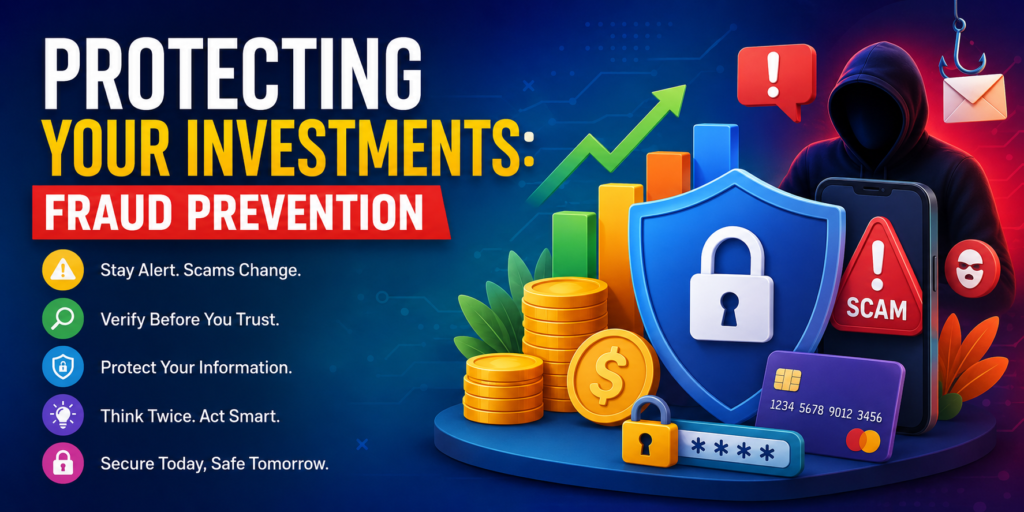
In today’s fast-changing financial world, investing has become more accessible than ever. Digital platforms, mobile banking, cryptocurrency, online brokers, and social media have opened new opportunities for people to build wealth. However, these same technologies have also created new opportunities for criminals.
Investment fraud has become a serious financial threat, with scammers using sophisticated techniques to manipulate investors and steal their money. The FBI’s 2024 Internet Crime Report reported approximately $6.6 billion in investment-fraud losses, representing a substantial increase compared with the previous year.
The growing scale of these losses shows why investors need to be cautious. Understanding common fraud techniques, recognizing warning signs, and developing strong security habits can make it much harder for criminals to succeed.
The Growing Problem of Investment Fraud
Investment fraud has emerged as one of the most damaging categories of financial crime. Scammers frequently target people who are looking for attractive returns, retirement opportunities, alternative investments, or quick ways to increase their savings.
According to FBI IC3 data, reported investment-fraud losses reached about $6.57 billion in 2024. Cryptocurrency-related scams have also become a major concern, with reported losses associated with cryptocurrency investment fraud increasing dramatically.
Several developments demonstrate how quickly the threat is expanding:
- Investment-fraud losses reached approximately $6.6 billion in 2024.
- Cryptocurrency-related fraud has become increasingly prominent.
- Older investors can face particularly serious financial consequences.
- Criminal organizations increasingly operate across international borders.
- Digital platforms make it easier for scammers to reach thousands of potential victims.
Fraud statistics also represent only reported incidents. Many victims do not report scams because of embarrassment, uncertainty, or the belief that their money cannot be recovered.
For investors, this makes prevention especially important. Once money has been transferred to a fraudster, recovering it can be extremely difficult.
Benefit Title One
Short bolded lead-in followed by a sentence explaining this benefit.
Benefit Title Two
Short bolded lead-in followed by a sentence explaining this benefit.
Benefit Title Three
Short bolded lead-in followed by a sentence explaining this benefit.
Understanding Common Investment-Fraud Techniques
Fraudsters continually change their methods. Modern scams are no longer limited to suspicious emails or poorly written messages. Criminals can now use professional-looking websites, convincing social-media profiles, fake investment dashboards, and artificial intelligence to appear legitimate.
Fake Investment Opportunities
One of the most common techniques involves presenting a completely fake investment opportunity. A scammer may advertise cryptocurrency, stocks, foreign exchange, real estate, or artificial-intelligence trading systems while promising unusually high returns.
Victims may initially see small profits displayed on an online dashboard. These numbers can be fabricated to encourage additional deposits. When the investor attempts to withdraw the money, the scammer may demand additional fees or taxes before disappearing.
Impersonation Scams
Fraudsters may pretend to represent banks, brokerage companies, government agencies, financial advisers, or well-known investment professionals.
They may contact investors by phone, email, messaging applications, or social media and create a sense of urgency.
Never assume that a caller or online contact is genuine simply because they know some personal information about you.
Romance and Relationship Scams
Some investment scams begin as personal relationships rather than financial conversations.
A fraudster may spend weeks or months building trust before introducing an investment opportunity. Once the victim feels emotionally connected, the criminal may encourage them to transfer money into a supposed investment account.
This combination of emotional manipulation and financial deception can result in significant losses.
Cryptocurrency Scams
Cryptocurrency has created new opportunities for both legitimate investors and fraudsters. Criminals may promote fake exchanges, fraudulent tokens, manipulated trading platforms, or supposed crypto-investment experts.
The use of cryptocurrency can make scams particularly difficult to reverse because transactions may be irreversible and international.
Artificial-Intelligence-Powered Fraud
Artificial intelligence is making scams more convincing. Criminals can create realistic messages, photographs, voices, videos, and online personas much faster than before.
Deepfake technology may even be used to imitate executives, celebrities, financial experts, or people known to the victim.
This means investors should no longer rely solely on spelling mistakes, poor grammar, or amateur-looking websites when judging whether something is fraudulent.
Pros & Cons
An honest look at trade-offs helps set proper expectations.
First pro title
Description of this advantage.
Second pro title
Description of this advantage.
Third pro title
Description of this advantage.
First con title
Description of this drawback.
Second con title
Description of this drawback.
Third con title
Description of this drawback.
Why AI Could Make Scams More Dangerous
Artificial intelligence is changing both legitimate financial services and criminal activity.
Fraudsters can use AI to automate communication, personalize messages, analyze publicly available information, and create convincing fake identities. Instead of manually contacting a small number of victims, criminals may potentially operate large-scale campaigns.
Several developments deserve attention:
- AI can generate highly convincing phishing messages.
- Voice-cloning technology can imitate familiar voices.
- Deepfake videos can make false endorsements appear authentic.
- Automated systems can communicate with victims around the clock.
- Fake investment advertisements can be produced at scale.
- Synthetic identities can combine real and fabricated personal information.
As these technologies improve, investors need to adopt stronger verification habits.
The important question is no longer whether a message looks professional. Instead, investors should ask whether the underlying person, company, investment opportunity, and financial information can be independently verified.
Warning Signs Every Investor Should Know
Recognizing red flags early can prevent major losses.
A common warning sign is a promise of guaranteed or unusually high returns with little or no risk. Legitimate investments always involve some degree of uncertainty.
Other warning signs include:
- Pressure to invest immediately.
- Claims that an opportunity is available for a limited time only.
- Requests to transfer money through unusual payment methods.
- Investment advice received unexpectedly through social media.
- Unverified trading platforms or websites.
- Requests for passwords, PINs, or one-time verification codes.
- Difficulty withdrawing funds.
- Demands for additional money before releasing supposed profits.
- Testimonials that cannot be independently verified.
- Investment professionals who cannot provide verifiable credentials.
A professional appearance does not guarantee legitimacy. Scammers can create sophisticated websites and convincing marketing material.
Build a Verification-First Mindset
One of the strongest defenses against investment fraud is simple: verify before you trust.
If someone contacts you with an investment opportunity, do not use the contact information they provide as your only method of verification.
Instead, independently find the company’s official website and contact details. Check whether the investment professional is properly registered or authorized where applicable. Research the organization using reliable sources and look for independent information rather than relying entirely on testimonials.
Before investing, consider asking:
- Who is offering this investment?
- Is the company properly registered or regulated?
- How does the investment actually generate returns?
- What are the risks?
- Can I independently verify the information?
- Why am I being pressured to act immediately?
- How will I withdraw my money?
- What fees or charges are involved?
If the answers are unclear, stepping away is often safer than proceeding.
Protect Your Online Investment Accounts
Strong digital security can reduce the chance of criminals gaining access to financial accounts.
Investors should use unique and strong passwords for brokerage, banking, cryptocurrency, and email accounts. Password managers can make it easier to maintain different credentials across multiple services.
Multi-factor authentication should also be enabled wherever available.
Additional security measures include:
- Never share passwords or one-time authentication codes.
- Keep operating systems and applications updated.
- Avoid logging into financial accounts through suspicious links.
- Use secure internet connections for financial transactions.
- Monitor account activity regularly.
- Turn on transaction notifications.
- Review statements for unfamiliar activity.
- Secure the email account connected to financial services.
- Avoid storing sensitive financial information unnecessarily.
Remember that your email account can be particularly important because criminals who gain access to it may attempt to reset passwords for other accounts.
Be Careful With Social Media Investment Advice
Social media has become an important source of financial information, but it is also a major channel for investment scams.
Influencers, anonymous accounts, fake experts, and impersonated celebrities may promote questionable investments. Some advertisements may use fabricated screenshots showing enormous profits.
Before acting on financial advice from social media, independently verify the claims.
Do not assume that an account is genuine simply because it has thousands of followers. Followers, comments, reviews, and testimonials can sometimes be manipulated.
Treat social media as a source of ideas rather than proof that an investment is legitimate.
Protecting Older and Vulnerable Investors
Fraud can affect anyone, but some scams specifically target older adults and people who may be less familiar with digital financial systems.
Family members can help by encouraging open conversations about unusual financial requests. A person who has been scammed may feel embarrassed and avoid telling anyone, allowing the criminal to continue the deception.
Useful protective measures include:
- Discussing suspicious investment offers openly.
- Reviewing financial accounts regularly.
- Using transaction alerts.
- Encouraging independent verification.
- Being cautious about unexpected calls and messages.
- Avoiding pressure-based financial decisions.
- Reporting suspected fraud as soon as possible.
Creating an environment where people feel comfortable discussing suspicious activity can prevent repeated losses.
What Financial Institutions Can Do
Fraud prevention is not only an individual responsibility. Banks, brokers, investment platforms, and other financial institutions also have an important role to play.
Organizations can use advanced analytics and machine-learning systems to identify unusual transactions and suspicious behavioral patterns.
They can also strengthen customer protection through:
- Real-time transaction monitoring.
- Identity verification.
- Behavioral analysis.
- Strong authentication systems.
- Employee fraud-awareness training.
- Customer education programs.
- Regular security assessments.
- Rapid response procedures for suspicious activity.
- Cooperation and information sharing across the financial industry.
Investment in fraud prevention can protect customers while also strengthening institutional reputation and trust.
What to Do If You Suspect Investment Fraud
If you believe you may have encountered an investment scam, act quickly.
Do not send additional money simply because the scammer claims that another payment will unlock your profits. Preserve emails, messages, transaction records, screenshots, account information, and other evidence.
Contact the financial institution or platform involved through independently verified contact information. Depending on the circumstances, you may also need to report the incident to the appropriate financial regulator or law-enforcement authority in your jurisdiction.
The sooner suspicious activity is identified and reported, the better the chances of limiting additional losses.
Go to Official PageKey Lessons for Investors
Investment fraud is becoming more sophisticated, but investors can still take practical steps to reduce their exposure.
The most important lessons include:
- Do your own verification before investing.
- Be skeptical of guaranteed returns.
- Never allow urgency to replace careful research.
- Protect passwords and authentication codes.
- Use multi-factor authentication whenever possible.
- Be cautious about investment advice received through social media.
- Do not trust screenshots or testimonials as proof of profitability.
- Verify financial professionals and companies independently.
- Monitor investment accounts frequently.
- Report suspicious activity quickly.
The goal is not to become afraid of investing. Investing can be an important part of long-term financial planning. The goal is to make decisions based on verified information rather than pressure, emotion, or unrealistic promises.
Looking Ahead: Staying Safe in a Changing Financial World
The future of financial fraud will likely be shaped by technology. Artificial intelligence, digital assets, automated communication, and increasingly sophisticated identity manipulation may create new challenges for investors.
At the same time, technology can also strengthen fraud prevention. Financial institutions can use advanced detection systems, behavioral analytics, authentication tools, and real-time monitoring to identify suspicious activity.
For individual investors, the most valuable defense remains a combination of knowledge, patience, verification, and strong digital security.
A convincing message does not necessarily mean a legitimate opportunity. A professional-looking website does not prove that a company is trustworthy. And an attractive return does not eliminate investment risk.
The safest approach is to slow down, investigate independently, understand the risks, and never allow someone else to make a financial decision for you under pressure.
Frequently Asked Questions
First question goes here?
Answer text with key phrase bolded for emphasis.
Second question goes here?
Answer text with key phrase bolded for emphasis.
Third question goes here?
Answer text with key phrase bolded for emphasis.
Conclusion
Investment fraud has evolved into a major financial threat, and modern technology has made scams more convincing, scalable, and difficult to recognize. From fake investment platforms and cryptocurrency schemes to impersonation, romance scams, synthetic identities, and AI-generated content, criminals have an expanding collection of tools for targeting investors.
However, investors are not powerless. A careful verification process, strong account security, skepticism toward unrealistic promises, and regular monitoring can significantly reduce the risk of becoming a victim.
The most important principle is simple: pause before you pay, verify before you trust, and research before you invest.
Protecting your investments is not only about choosing the right assets. It is also about protecting the money, information, and accounts that make your financial goals possible. By staying informed and adopting responsible security habits, investors can approach opportunities with greater confidence while keeping fraudsters at a safe distance.