The Balance Between Risk and Innovation
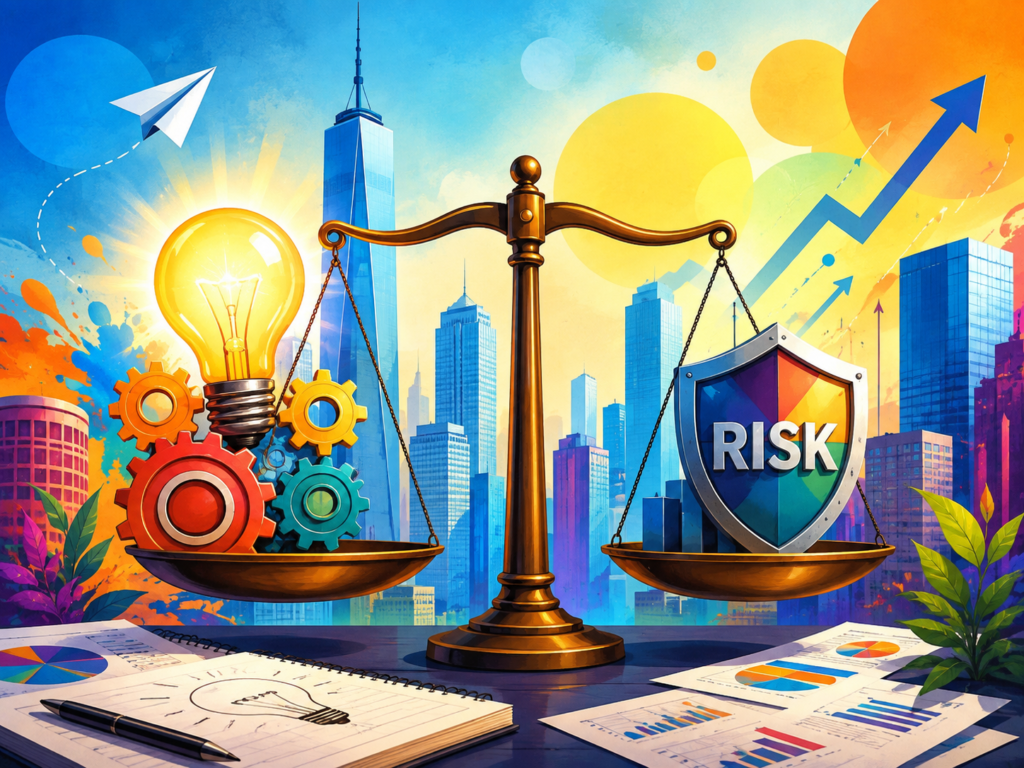
In today’s rapidly changing business environment, organizations must constantly balance the pursuit of new opportunities with the need to protect themselves from potential setbacks.
Innovation can create major growth opportunities and competitive advantages, but pursuing new ideas without adequate safeguards can result in financial losses, operational problems, or damage to a company’s reputation.
Finding the right middle ground between experimentation and protection is essential for sustainable growth and long-term business stability.
Whether a company is a startup or a multinational corporation, this balance helps organizations explore new possibilities while protecting their essential resources and capabilities.
The Importance of Innovation and Risk Management
Innovation plays a central role in business development by helping organizations respond to changing customer expectations, emerging technologies, and evolving markets.
Companies that consistently invest in new ideas can discover better products, more efficient processes, and new sources of revenue.
However, innovation also introduces uncertainty. A new product may fail to attract customers, a technology investment may not deliver expected results, or an aggressive expansion strategy may create financial pressure.
Risk management provides a structured way to handle these uncertainties.
Rather than preventing organizations from taking risks, effective risk management helps businesses make informed and measured decisions.
When innovation and risk management operate together, companies can pursue ambitious goals while maintaining appropriate safeguards.
Benefit Title One
Short bolded lead-in followed by a sentence explaining this benefit.
Benefit Title Two
Short bolded lead-in followed by a sentence explaining this benefit.
Benefit Title Three
Short bolded lead-in followed by a sentence explaining this benefit.
Common Challenges in Finding the Right Balance
Creating harmony between innovation and risk is not always straightforward.
Organizations frequently face competing priorities, limited resources, and uncertainty when introducing new products, technologies, or strategies.
Some common challenges include:
- Investing heavily in ideas that have not yet been properly validated.
- Increased cybersecurity exposure caused by rapid technology adoption.
- Difficulty predicting whether customers will accept a new product or service.
- Conflicts between innovative teams and departments that prioritize stability and risk reduction.
- Infrastructure limitations when business growth happens faster than expected.
These issues can slow innovation or create unnecessary exposure to losses.
Business leaders therefore need to evaluate opportunities carefully while remaining flexible enough to respond when market conditions change.
Strategic Approaches for Balancing Risk and Innovation
A structured strategy can help organizations encourage creativity without exposing the entire business to unnecessary risks.
One useful approach is to establish formal risk evaluation processes that identify, measure, and prioritize potential threats.
Companies can also use controlled experiments and pilot projects before committing substantial resources.
Several practical approaches include:
- Risk evaluation: Examine the likelihood and potential consequences of different risks.
- Risk reduction: Use diversification, backup plans, insurance, and other safeguards where appropriate.
- Risk appetite: Establish clear boundaries for the amount and type of risk the organization is willing to accept.
- Agile development: Test ideas in stages and make improvements based on results.
- Data-driven decision-making: Use analytics and relevant information to support investment and innovation decisions.
These methods allow organizations to experiment while limiting the potential damage caused by unsuccessful initiatives.
Building a Supportive Culture and Strong Leadership
The relationship between risk and innovation is also influenced heavily by organizational culture.
Leaders should create an environment where employees feel comfortable proposing new ideas while understanding the importance of responsible decision-making.
A risk-conscious culture that supports carefully planned experimentation can help organizations become both innovative and resilient.
Important steps include:
- Integrating risk awareness into everyday business decisions.
- Establishing specialized innovation teams for experimental projects.
- Encouraging cooperation between technical, financial, operational, and creative departments.
- Creating feedback systems that help teams learn from both successful and unsuccessful experiments.
- Giving employees appropriate freedom while maintaining clear accountability.
When employees understand that failure can be a learning opportunity rather than an automatic punishment, they may become more willing to experiment responsibly.
Strong leadership ensures that innovation remains connected to the organization’s broader objectives.
Real-World Applications
Examples from different industries demonstrate how organizations can combine innovation with appropriate risk controls.
Large healthcare and pharmaceutical organizations, for example, must carefully evaluate safety, regulatory, financial, and operational risks while developing new treatments and technologies.
A company introducing a new digital service may similarly begin with a limited pilot program before rolling it out to its entire customer base.
Small businesses can apply the same principle.
A local café might introduce online ordering or delivery services without completely changing its existing operating model. Testing the service on a smaller scale can reveal customer demand, operational challenges, and potential costs before a larger investment is made.
Other examples include:
- Large organizations creating separate innovation divisions for experimental initiatives.
- Boards establishing risk appetite guidelines for technology and digital transformation projects.
- Cross-functional teams combining different areas of expertise when evaluating new opportunities.
- Businesses using pilot programs to test products before committing significant capital.
- Companies reviewing unsuccessful projects to identify lessons that can improve future decisions.
These approaches demonstrate that responsible innovation does not mean avoiding uncertainty. Instead, it means managing uncertainty intelligently.
Pros & Cons
An honest look at trade-offs helps set proper expectations.
First pro title
Description of this advantage.
Second pro title
Description of this advantage.
Third pro title
Description of this advantage.
First con title
Description of this drawback.
Second con title
Description of this drawback.
Third con title
Description of this drawback.
Metrics and KPIs for Measuring Performance
Organizations need reliable measurements to determine whether their innovation strategies are producing worthwhile results.
Key performance indicators can reveal whether investments are generating value while also showing whether risks are being controlled effectively.
Useful measurements include:
- Innovation success rate: Percentage of initiatives that achieve their defined goals.
- Risk mitigation effectiveness: Ability to reduce the financial or operational impact of identified risks.
- Time-to-market: Time required to move an idea from development to commercial launch.
- Return on investment: Financial value generated compared with resources invested.
- Portfolio distribution: Balance between established products, emerging opportunities, and transformational projects.
- Employee participation: Level of employee involvement in innovation programs.
- Customer response: Feedback and adoption rates for newly introduced products or services.
Tracking these indicators helps leadership teams identify weaknesses and adjust their strategies.
The goal is not simply to increase the number of innovative projects but to ensure that innovation produces meaningful and sustainable value.
Go to Official PageBroader Context and Business Implications
The need to balance innovation and risk applies across virtually every industry.
In healthcare, organizations must pursue medical and technological advancements while maintaining patient safety and regulatory compliance.
In technology, companies must move quickly to remain competitive while addressing cybersecurity, privacy, reliability, and operational risks.
In manufacturing, innovation can improve productivity and automation, but businesses must consider implementation costs, workforce requirements, and system reliability.
For financial organizations, new digital services can improve customer experiences while simultaneously introducing new regulatory and cybersecurity considerations.
Across these sectors, the central principle remains the same: innovation should create opportunity without compromising the organization’s ability to remain stable and resilient.
Companies that successfully manage this relationship can respond more effectively to disruption and changing market conditions.
Creating a Sustainable Innovation Strategy
Organizations should treat risk and innovation as complementary rather than opposing forces.
Innovation provides the opportunity to move forward, while risk management helps ensure that progress does not threaten the organization’s long-term stability.
A sustainable approach begins with clearly defined objectives.
Before launching a major initiative, leaders should understand what they hope to achieve, what resources are required, what could go wrong, and how success will be measured.
Small-scale experimentation can then provide valuable information before larger commitments are made.
Regular reviews are equally important because risks and opportunities can change as markets, technologies, regulations, and customer expectations evolve.
By combining experimentation, data, collaboration, and thoughtful risk assessment, organizations can build a stronger foundation for long-term growth.
Frequently Asked Questions
First question goes here?
Answer text with key phrase bolded for emphasis.
Second question goes here?
Answer text with key phrase bolded for emphasis.
Third question goes here?
Answer text with key phrase bolded for emphasis.
Conclusion
Balancing risk and innovation is one of the most important challenges facing modern organizations.
Too much caution can prevent companies from adapting and discovering new opportunities, while uncontrolled experimentation can expose them to unnecessary financial, operational, and reputational damage.
The most effective organizations create systems that allow employees to experiment, learn, adapt, and innovate within clearly understood risk boundaries.
Through strong leadership, structured risk assessment, controlled experimentation, cross-functional collaboration, and meaningful performance measurement, businesses can pursue innovation without losing sight of stability.
Ultimately, the goal is not to eliminate risk or pursue innovation at any cost. It is to develop the ability to take calculated risks that support meaningful progress.
When organizations master this balance, uncertainty can become an opportunity for learning, growth, resilience, and long-term competitive advantage.